Two GCE A Level Students on Thinking Through the International Chemistry Quiz

{{ vm.tagsGroup }}

30 Oct 2026

4 Min Read

Chai Hao Zheng, Leong Au Yang (Contributing Writers), The Taylor’s Team (Editor)

IN THIS ARTICLE

With about five minutes left in the International Chemistry Quiz (ICQ), Chai Hao Zheng returned to a diagram question he had left unanswered. He remembers finding a way into it by drawing the diagram and picturing how the pieces fitted together.


Leong Au Yang also remembers an unfamiliar diagram task. He recalls misreading the fractions represented in the image and losing a mark. Looking back, he felt he had been too confident about a question that appeared straightforward.


Both were studying at A2 stage in Taylor’s College’s General Certificate of Education – Advanced Level (GCE A Level) programme. The College’s preliminary results report records a score of 29 out of 30 and a High Distinction for each of them in the quiz held on 6 August 2026. Their reflections offer a closer look at the work behind those scores, including the questions that made them pause.


Organised by the Royal Australian Chemical Institute, the ICQ invites students to apply chemistry knowledge to unfamiliar problems. For Hao Zheng and Au Yang, much of the preparation came through their regular studies.
Preparing Through GCE A Level Chemistry

Hao Zheng chose to concentrate on understanding his syllabus rather than preparing separately for the ICQ. He used topic-based exercises to work on areas he found difficult, and often stayed on campus after classes because he found it easier to focus there than at home.


Au Yang described a daily routine of chemistry study and past-paper practice. He also paid attention to how he was studying: was he understanding a concept, or simply taking in information? Working through papers helped when it exposed something he needed to understand more clearly.


Applying ideas in new situations is part of the Cambridge International AS & A Level Chemistry syllabus. Both students drew on that subject knowledge in the quiz, while encountering tasks that looked different from those they were used to practising.

Working Through an Unfamiliar Question

The diagram Hao Zheng recalled required him to work out the number of atoms represented. He had completed the other questions before returning to it. With little time remaining, drawing it out helped him visualise the problem and find an approach.


Au Yang recalls treating parts of an atom shown in a diagram as quarters when they represented eighths. He described this as the only question he answered incorrectly, and attributed the mistake to overlooking a detail and being overconfident.


The result gave him satisfaction that his sustained work was paying off. The error stayed with him too. He felt it reminded him to give a question his full attention, even when it initially looked easy.


For Hao Zheng, the experience strengthened an existing preference for understanding concepts. ‘Questions may change and waver; concepts remain the same,’ he wrote. It was his advice to other students, drawn from the approach he found useful.

Learning with Ms Leong’s Guidance

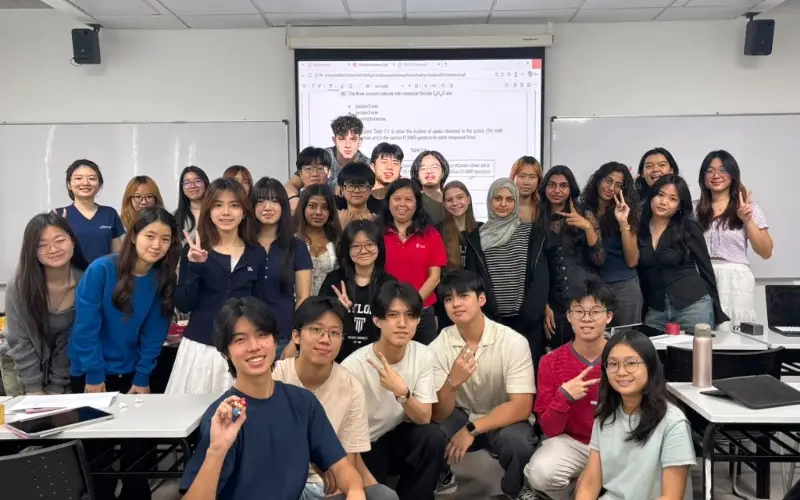
A classroom group gathered around a person in a red shirt, with a chemistry worksheet projected behind them.

Both students described turning to their chemistry lecturer, Ms Leong Yoke Woon, when they needed help. Their examples show what that assistance involved.


Hao Zheng recalled being hesitant before his first consultation. During that exchange, Ms Leong asked him questions in sequence, helping him work towards an answer. Only afterwards did he realise how much of the reasoning he had done himself.


He also valued her explanations and self-prepared notes. As consultations became a more regular part of his study, he continued to spend time on a problem before asking for help. If he felt close to solving it, he said, he might try for half an hour first.


Au Yang described sending Ms Leong questions when he was confused and receiving detailed explanations. One consultation concerned the distinction between the conjugate acid and conjugate base of a chemical species. Her explanation helped him recognise a misunderstanding, and he recalled applying that clarification in later practice by returning carefully to the definitions.


The consultations gave them help they could return to in their studies. Both students also described time spent trying to work through questions on their own.

Sustaining Study in Different Ways

Their classmates mattered to both students, though their study preferences differed.


Hao Zheng preferred studying alone. Being surrounded by peers working towards their own goals still helped motivate him, and he felt there were qualities he could learn from them. He wanted to measure his progress against his earlier work, rather than compare results with his friends.


Au Yang placed more emphasis on studying together on campus. Friends helped him keep a consistent routine, and spending time together afterwards offered relief from studying. In his response, he was keen for their contribution to be recognised.


They found different ways to sustain their study, working independently or alongside friends and taking questions to a lecturer when they needed help. For Au Yang, the result affirmed his effort while leaving him with a detail he would read more carefully next time.

If their experiences have you considering how you would like to study chemistry next, explore the subject choices in Taylor’s College’s GCE A Level programme.

YOU MIGHT BE INTERESTED
{{ item.articleDate ? vm.formatDate(item.articleDate) : '' }}
{{ item.readTime }} Min Read