
Justin traces one ordinary observation through a small drone attempt, practical Engineering, difficult Chemistry, and the questions he kept choosing to revisit.
{{ vm.tagsGroup }}
23 Aug 2026
5 Min Read
Justin Khoo Jon Le (Contributing Writer), The Taylor’s Team (Editor)
Justin traces one ordinary observation through a small drone attempt, practical Engineering, difficult Chemistry, and the questions he kept choosing to revisit.
My Engineering journey did not begin with a grand plan, a polished invention or even a particularly impressive object. It began with a fly in a bathroom.
I watched it circle the light again and again, wondering why it moved that way. The question was small enough to ignore, but it stayed with me. Later, I picked up Feedback Systems: An Introduction for Scientists and Engineers. I still did not know exactly why the fly moved that way, but the ideas of movement, sensing and control gave me a new way to think about the question.
I kept returning to the question, and each attempt changed it. That became more useful to me than finding one quick answer. Curiosity, I learnt, is not always a sudden passion. Sometimes it is a question that refuses to leave.
What interested me was the contrast between the fly’s movement and the machines I understood. The fly appeared agile, responsive and able to change direction quickly. A conventional drone also relies on continuous adjustment, but its movement comes from a system of motors, sensors, and control decisions that must work together.
The more I read, the less the original question felt like a search for one simple explanation. It opened other questions. How does a flying system stay stable when the environment changes? How quickly can it correct a disturbance? What does it mean to balance agility with control?
I did not have complete answers, and that became part of the appeal. The observation gave me a direction for exploration without requiring me to know where it would end.
To better understand the problem, I tried to build a small ESP32 drone with four motors. Calibrating the motors for directional movement showed me how difficult conventional control already was. If one part of the system behaved differently from the others, the effect could spread through the whole movement.
The attempt did not produce a miniature machine capable of flying like an insect. It made the gap between that idea and reality clearer. Once I saw how hard conventional control already was, I began wondering how much harder it would be to recreate insect-like agility at a small scale, with the added challenges of sensing, weight, power and rapid correction.
That was a valuable result. Building something does not have to end in a finished invention to sharpen a question. The drone gave me a physical way to encounter the limits that diagrams and reading had only described.
I met a different kind of control problem during an internship at an engineering firm. The firm had built a machine for assembling very small pogo-pin components, but many assemblies were failing, and I was asked to analyse the cause of the inconsistency.
I drew on Cambridge A Level Physics ideas about percentage uncertainty. My conclusion was that small variations across several inputs were combining and making the final result less consistent. I prepared a report identifying the variables and sources of inconsistency.
Working in a warehouse-style space around heavy machinery felt very different from solving a classroom exercise. I could not treat the task like a problem with perfectly controlled inputs. I had to observe what varied, decide what could be measured and communicate the limits of what I could conclude. That was when the Physics concept became useful: a real system refused to behave consistently.
Not every important part of my Cambridge A Level experience came from a subject I immediately enjoyed. The transition from SPM Chemistry was difficult because much of the content felt new. Hess’s Law diagrams and flowcharts confused me, and a demanding quiz exposed how weak my foundations still felt.
Ms Jhoshna, my Chemistry lecturer at Taylor’s College, kept reinforcing those foundations and used analogies and stories to make difficult ideas more memorable. She brought snacks to keep students energised and regularly checked on the progress and wellbeing of those applying to UK universities.
Her care did not make the subject easy, but it made returning to the difficult parts feel worthwhile. As my understanding improved, so did my interest. I learnt that support can be both kind and demanding: someone can take your struggle seriously without lowering the expectations.
Ms Jhoshna also reviewed my UCAS personal statement and encouraged me to write with more emotional depth and to reflect more sincerely on my projects. That advice changed how I described my work. A project was not valuable because it sounded technical. I had to explain what I had noticed, what had failed and why I kept returning to the question.
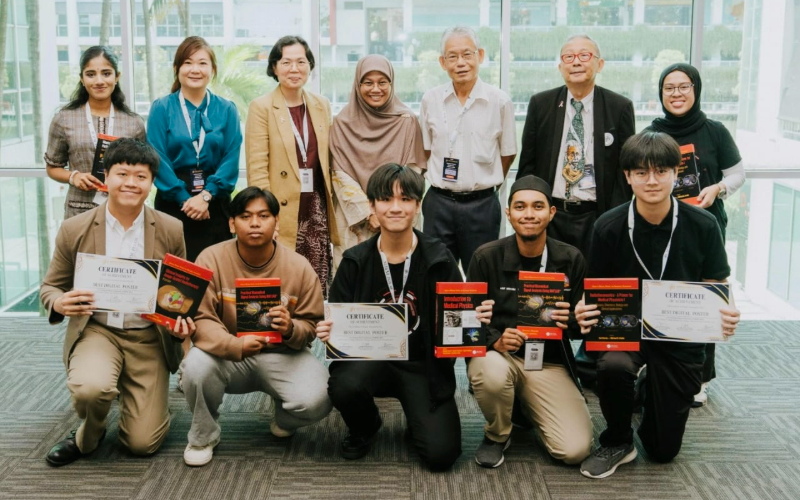
I eventually turned the fly-and-control question into a poster titled “Towards Smarter Drones: Control Systems Inspired by Insect Aerodynamics” at the National Physics Conference 2025. In the poster, I explored how small drones might remain stable and agile while dealing with wind and limited energy storage. I did not claim to solve insect-inspired flight; the project helped me organise the questions that had accumulated.
The poster received the Top Overall Poster Presentation Award, and I ranked first among the competition participants. The recognition was encouraging, but the more important pattern was that an ordinary observation had survived several encounters with reality: reading complicated the question, the drone exposed control difficulties, the internship made uncertainty practical, and Chemistry taught me to return to difficult material with more patience.
I have received an offer for Imperial College London’s four-year MEng in Electrical and Electronic Engineering. I do not think the fly led directly to Imperial, and I did not begin with a complete career plan. I see the course as the next place to examine the kinds of systems and questions I have found myself revisiting.
For high school students, pay attention to what you return to without being told. It might be a subject, a hobby or a question that seems too ordinary to matter. You do not need to call it a passion immediately. Give it time, test it in different ways and notice whether it continues to make you curious.
If you are still discovering which questions keep drawing you back, exploring Cambridge A Level at Taylor’s College can be one way to keep testing where that curiosity might lead.
Justin is a Cambridge A Level student at Taylor's College interested in Electrical and Electronic Engineering, control systems, and the questions hidden inside ordinary observations.