
Joe Han reflects on how a demanding Mathematics lesson, supportive questioning and hands-on work helped him stop waiting to feel ready.
{{ vm.tagsGroup }}
23 Aug 2026
5 Min Read
Ng Joe Han (Contributing Writer), The Taylor's Team (Editor)
Joe Han reflects on how a demanding Mathematics lesson, supportive questioning and hands-on work helped him stop waiting to feel ready.
The page in front of me was blank. In an early Probability and Statistics lesson, Ms Logesh asked our class to derive the formula for variance and standard deviation from first principles. I knew the formulas, but that was not the same as being able to construct the reasoning behind them.
That moment showed me what the move from SPM to Cambridge A Level would require. Remembering a method would not always be enough. I would have to understand where it came from, connect ideas logically and keep working when a familiar-looking question no longer offered a familiar route.
At first, that level of thinking was intimidating. Looking back, however, the blank page did not mark the point at which I discovered whether I was ready. It marked the point at which I began building the confidence to participate before I had a complete answer.
I used to associate confidence with knowing what to do immediately. A difficult question challenged that assumption. If I could not see the next step, I thought the solution was out of reach.
Deriving a result from first principles required a different response. I had to return to what each term meant, ask which relationships I already understood and build the argument piece by piece. The process was slower than recalling a formula, but it also made the result feel less fragile. I was no longer depending entirely on whether the question resembled one I had practised.
The lesson was not that every problem should begin with a blank page. It was that uncertainty could be part of learning rather than evidence that I did not belong in the subject. That distinction became important when I started contributing more openly in class.
Ms Ilaya, my Mathematics lecturer at Taylor's College, regularly invited students to answer difficult questions and offered patient hints that connected unfamiliar problems to topics we had already learnt. Her approach did not remove the challenge. It gave us a way to re-enter it.
Each time I proposed a solution and found that I could make progress, I became more comfortable thinking aloud. The change was gradual. I noticed it when I began volunteering answers several times without waiting to be called on.
Speaking up carried a small risk: my first idea might be incomplete. But it also meant the idea could be tested, corrected and improved. Confidence, I realised, was not something I had to acquire privately before taking part. It could grow because I took part.
That mattered beyond the classroom. When I later encountered a technical problem with no worked example and no perfectly tidy set of assumptions, I was more willing to begin.
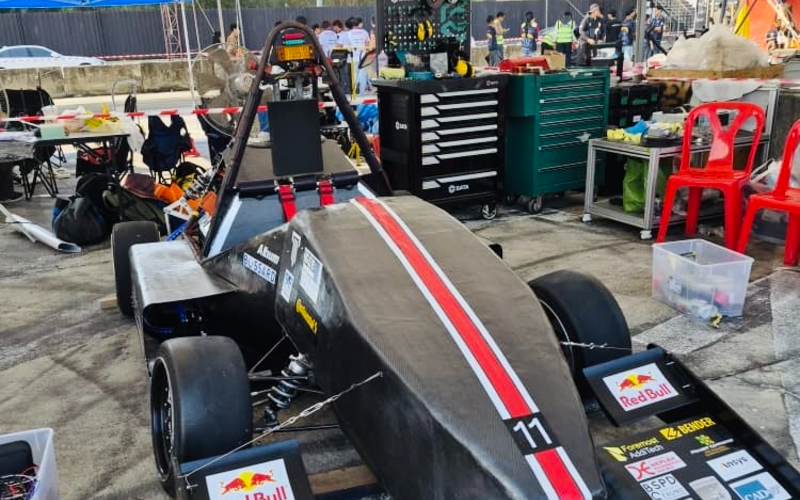
I took on pressure-drop estimation for the cooling loop of Taylor's Racing Team's electric vehicle. Pressure drop is the reduction in fluid pressure as coolant moves through pipes and components. Estimating it matters because the pump must keep the coolant circulating through the system.
I researched vehicle cooling approaches, reviewed technical papers, and used fluid properties and manufacturer data to develop my calculations. I knew they were not a final answer; I still had to account for uncertainty and the need for later testing.
What gave the task meaning was that I had to decide how to approach an unfamiliar system. There was no lecturer waiting to provide the next hint. I had to identify what information was available, recognise what was missing and explain why my assumptions were reasonable enough to continue.
I modelled the cooling loop and its components in SolidWorks to think through their sequence and pressure requirements. That was when I came to understand more clearly that every Engineering decision belongs to a larger system.
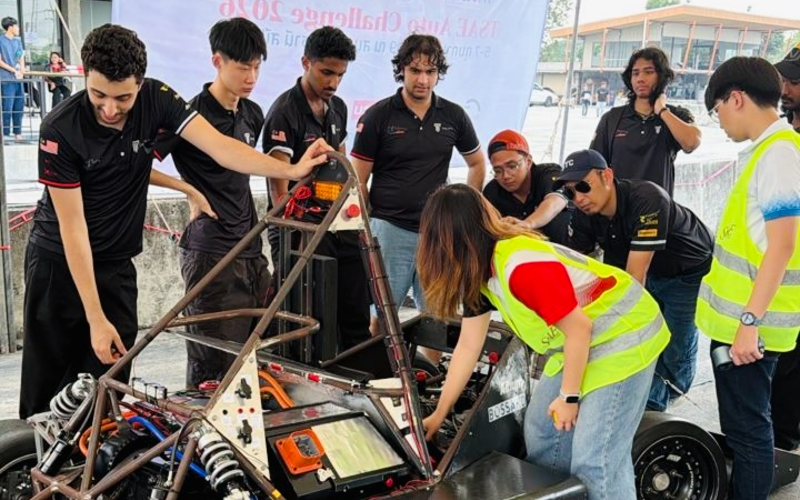
On paper, components connect neatly. In a physical build, a hose can be too stiff, a bend can create a kink, and a clamp can sit in a place where there is barely enough room to tighten it. Cutting brackets, routing piping and fitting parts showed me how quickly an elegant diagram meets the realities of material and space.
I helped assemble brackets and piping and check for leaks. That work showed me that a calculation can narrow the choices, but a workable design also depends on whether people can build, inspect and maintain it.
Working with the Aerodynamics team introduced a trade-off: a larger radiator surface could support cooling but could also increase drag. One team could not optimise its own part in isolation and assume the whole vehicle would improve. We had to communicate the trade-off and work within shared constraints.
That experience changed the way I viewed textbook problems. Their clean boundaries are useful because they let us learn the principles. Real hardware then asks whether we can carry those principles into a situation where the boundaries are less convenient.
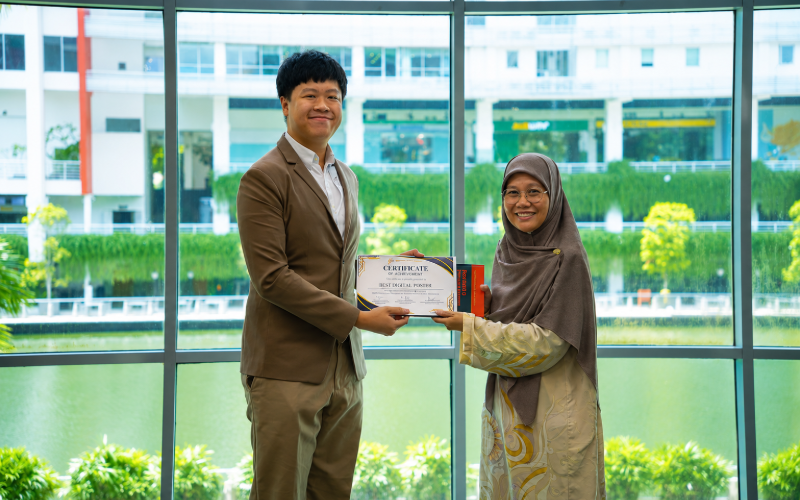
The same habit of organising an incomplete answer helped when I had to explain technical ideas under pressure. At the National Physics Conference 2025, I presented a poster titled Quantum Dot Lasers on Silicon: Enabling the Photonic Future and received the Best Digital Poster Award. Preparing to answer questions from specialists reminded me that communication is another form of problem-solving: understand what is being asked, select the relevant idea and make the reasoning clear.
I have received an offer to study Engineering at the University of Cambridge. I do not see the offer as evidence that I was already prepared for every challenge when I entered Cambridge A Level. My experience suggests the opposite: preparation developed because I kept attempting things that initially felt beyond me.
For students looking at pre-university study, confidence does not have to be an entry requirement. Start with the problem in front of you. Break it down, propose an answer, listen to what does not work and try again. The first attempt may not be elegant, but it gives you something that a blank page cannot: a place from which to improve.
If you are interested in where that kind of challenge could take you, you can explore Cambridge A Level at Taylor's College without waiting to feel completely ready first.
Joe Han is a Cambridge A Level student at Taylor's College with an interest in Engineering and the point where careful calculations meet physical constraints.