Why We Rebuilt a Dougong Model Three Times

{{ vm.tagsGroup }}

03 Nov 2026

4 Min Read

Wong Kenji (Contributing Writer), The Taylor’s Team (Editor)

IN THIS ARTICLE

The part we needed next had already been placed in the wrong position. We could not continue, so our group had to take the structure apart and work backwards until we found the mistake.


That happened more than once. By the time our miniature dougong finally came together, we had rebuilt it three times.


I joined the six-day Hangzhou mobility programme while completing the Final Design Project in my Taylor’s Diploma in Interior Design. I expected the experience to develop my understanding of structural elements and material handling. The workshop gave me a much more specific problem to solve.
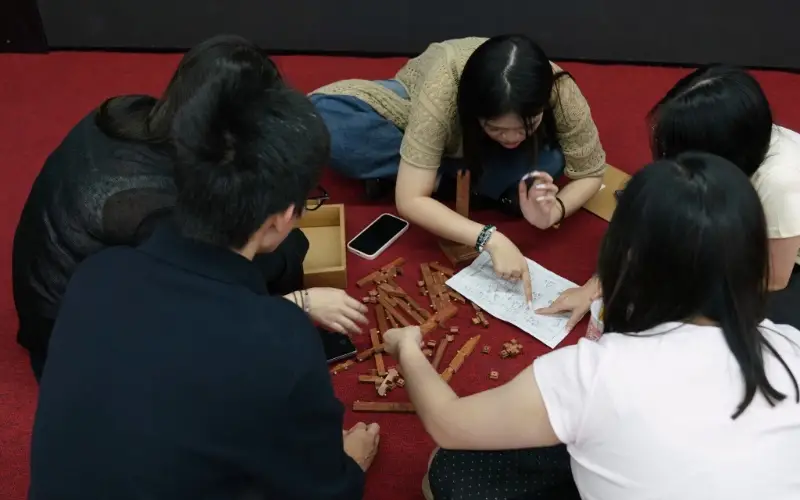
Students sit on a red carpet around wooden model components and an assembly diagram during a group dougong workshop.

Students work through the parts of a miniature dougong and its assembly diagram during the workshop at the China Academy of Art.

When the Next Piece Wouldn’t Fit

During a workshop at the China Academy of Art’s Xiangshan Campus, we worked in groups to dismantle and assemble a miniature dougong. The term refers to an interlocking bracket set associated with traditional Chinese timber architecture.


Before the programme, I thought traditional joinery was mainly about placing components together. The model made that assumption difficult to maintain. Each piece had a particular position, and the order mattered. When we chose the wrong part, the error did not always become obvious immediately. Sometimes we discovered it only when we reached the next step and could not proceed.


At another point in the process, we realised that a component we needed later had already been used in the wrong place. The model gave us no shortcut around the mistake. We had to dismantle what we had assembled and trace the sequence again.

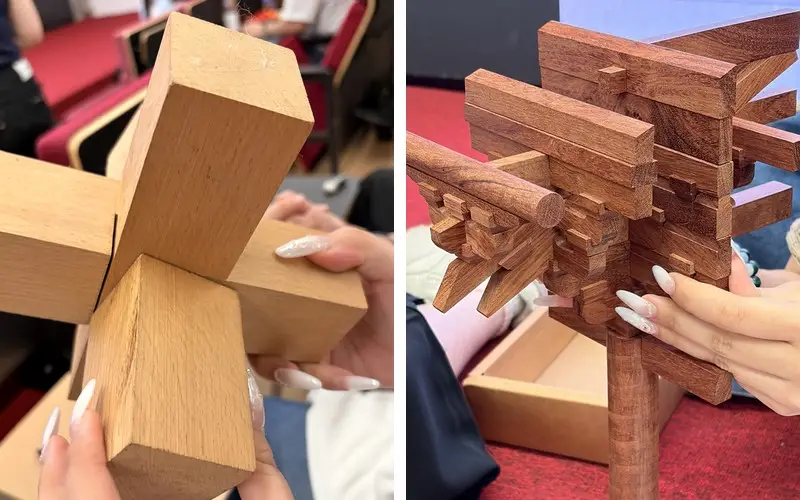
Left, hands support several interlocking wooden pieces in a workshop room; right, hands hold an assembled wooden dougong model with layered horizontal and vertical components.

Each piece has a particular position, and the order of assembly decides whether the next step is possible.

Why We Had to Start Again

The failed attempts changed how we approached the pieces in front of us. Several looked similar, so we began separating and identifying them before continuing. We double-checked each component, its position and whether it fitted snugly.


Those checks sound simple, but skipping one had a visible consequence: the next stage became impossible. The model made precision visible while we were working. An early placement could decide whether the next step was possible.


Our successful attempt came from paying closer attention before placing each piece. I began to understand that assembly depends on decisions made several steps earlier. If one of those decisions is wrong, adding more pieces does not solve it.

One Missing Part Changed How I Prepared

At one point, we also found that a component was missing. Without it, we could not move forward. A facilitator later helped us, but before that happened, I had already started thinking about how we had prepared for the task.


We should have identified every part at the beginning. Knowing what was available, which pieces were similar and where each one belonged would have made the later steps easier to manage.


That was the most useful lesson for me. A small component can affect what becomes possible next, but so can the way we organise the work before construction begins. I now pay more attention to what each element is for, where it belongs and what depends on it.

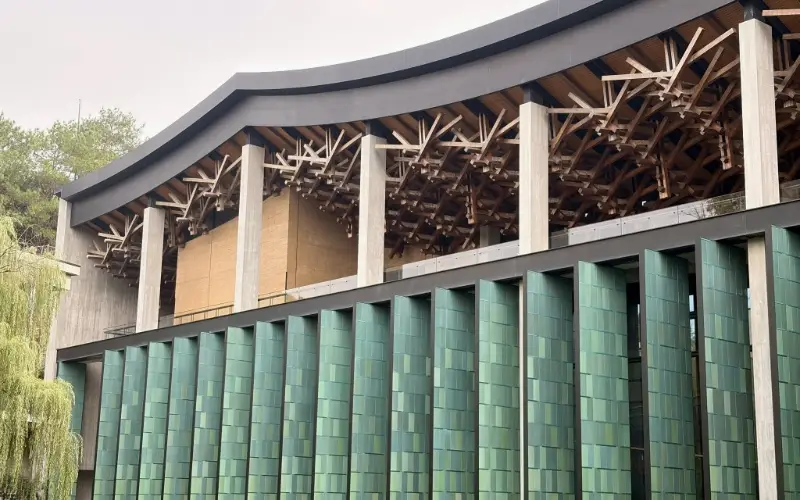
Wenrun Pavilion exterior with green vertical facade panels, pale columns and branching wood-toned roof members.

Wenrun Pavilion in Hangzhou, whose roof recalled the dougong model from the workshop.

Looking Up at Wenrun Pavilion

Later in the programme, we visited Wenrun Pavilion, the Hangzhou branch of the China National Archives of Publications and Culture in Yuhang District. Looking up at the building, I noticed a roof feature that reminded me of the workshop model. From where I stood, I could also see green facade panels catching the light at an angle.


That resemblance changed where I looked next. Instead of seeing only the overall form, I found myself watching how repeated elements met and how the structure appeared to move from one level to another.

Giving Every Design Element a Purpose

The experience also brought me back to an early Design Technology class. We had studied reinforced-concrete columns and beams and how loads move through structural elements. While working with the model, I thought about the route from the top towards its base.


Handling the parts gave me another way to revisit something I had studied. I could make a choice, see where the sequence stopped and work back towards the cause.


As I continue with interior design, I want to carry that working habit into my projects. Designing with purpose means asking what each element is doing and why it occupies that place. It also means checking whether an early decision will make the next one possible.

If you want to explore how creative ideas meet spatial and technical decisions, see how Taylor’s Diploma in Interior Design approaches materials, drawings and model-making.

YOU MIGHT BE INTERESTED
{{ item.articleDate ? vm.formatDate(item.articleDate) : '' }}
{{ item.readTime }} Min Read