Diploma in Digital Design Students Win Awards for Purpose-Driven Innovations

{{ vm.tagsGroup }}

10 Aug 2026

5 Min Read

Taylor's Team (Editor)

IN THIS ARTICLE

The IE²C Innovation Challenge brings together projects that respond to real-world problems across Science & Tech, Science Social, and Innovation in Teaching & Learning. Among this year's Bronze Award recipients were three Diploma in Digital Design (DIDD) teams from Taylor's College, whose projects addressed student well-being, early childhood learning and financial literacy. While each project tackled a different challenge, they shared the same design approach: understanding the people they were designing before developing the technology.


The award-winning projects were supervised by lecturers Nurshamine Nazira and Stanley Zhang Zimeng.


Describing what students gained from participating in the competition, Nurshamine Nazira said, ‘Innovation is not only about producing a successful outcome, but also about learning through experimentation, testing, and iteration. By taking their classroom projects into an innovation competition, students had the opportunity to evaluate their ideas beyond an academic setting and communicate the value of their work to a wider audience.’

Chill-O Jelly: Designing for the Student Reaching Burnout

high-res-youtube-video
Audio Gif

Somewhere between deadlines and a full class schedule, a student has a few minutes and no easy way to reset. That gap is what Chill-O Jelly was designed to address.


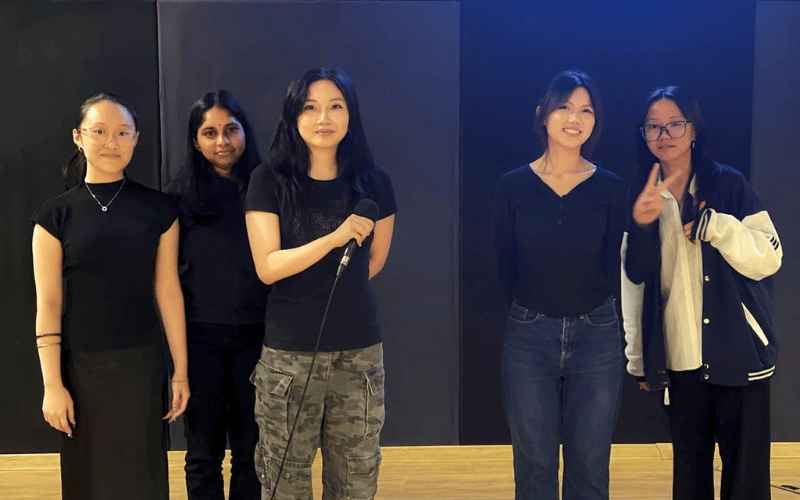
Won Ying Ying, Alyssa Ava Lau, Charmaine Chong Xiao Yin, Tan Nuo Han, and Tevasunri built a soft, squeezable object wired to a Force-Sensitive Resistor and an Arduino Mega 2560. Squeeze it, and the pressure feeds into a digital jellyfish built in TouchDesigner where the particles scatter wider, then settle back down as you let go.


None of them had used TouchDesigner before. Getting it to communicate with the Arduino was one of the team's biggest early obstacles, and they had to solve it fast because the subject runs during the short semester, leaving just over a month for the whole project. When someone hit a wall, another team member would sit down and troubleshoot them.

Chill-O-Jelly team

Ying Ying, who leads the group, remembers the moment it finally worked, when the sensor responded in real time, the jellyfish reacting the way they'd pictured it. ‘It made us realise that with teamwork and determination, we were capable of achieving something much more advanced than we initially expected.’


Tested with 20 participants, the prototype scored 95% for usability and around 90% for stress-reduction effectiveness. Visual appeal scored lower, at approximately 70%, a gap the team is already working close, by sharpening the sensor's accuracy and adding more vibrant colours.

Press and Play: Encouraging the Four-Year-Old to Learn Through Storytelling and Touch

high-res-youtube-video
Audio Gif

While Chill-O Jelly focuses on students' well-being, Press and Play turns to a younger audience, exploring how physical interaction and storytelling can make learning more engaging for children.


Developed by Tee Xin Yi, Chia Jia Ying, Lee Ying Ying, Tai Wei San and Tang Qian Ying, Press and Play is an interactive storytelling project for children aged four to seven. Using Arduino and arcade buttons, it lets children choose animated stories about animals that live in the sea, jungle and sky.


One of the trickiest challenges wasn't visible on screen at all. Although the arcade buttons worked as intended, the animations failed to respond because Arduino and Unity weren't communicating properly. After troubleshooting with lecturer Nurshamine Nazira, the team identified a software conflict that prevented the two systems from connecting. Resolving the issue allowed them to continue testing the prototype and improving the experience based on user feedback.

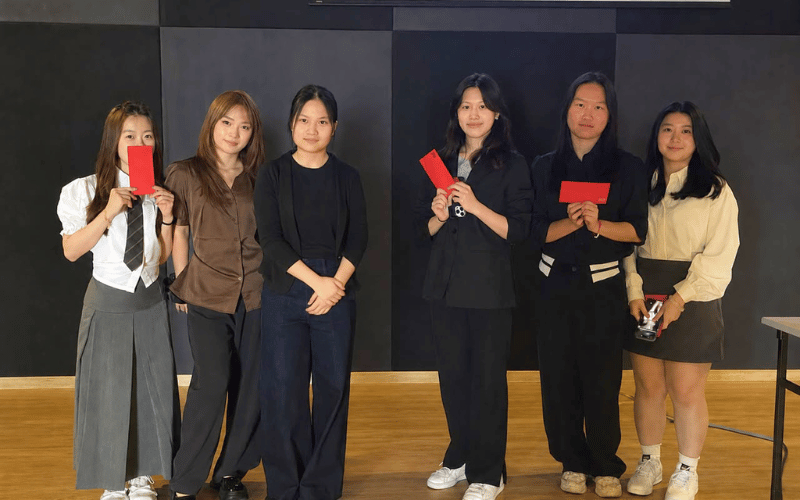
Press and Play team

The bigger lesson came during the prototype showcase. As children interacted with the experience and guests shared their feedback, the team realised that busy backgrounds and stronger sound effects sometimes distracted children from the story. Simpler visuals and clearer interactions helped them stay focused instead.


Group leader Xin Yi reflected, 'At first, we thought that adding more visual effects and sound effects would make the experience more exciting. However, we discovered that simpler and clearer animations were more suitable for young children because they could focus better on the story.'


The feedback prompted the team to simplify visual elements, adjust the audio balance, and improve the feedback button. More importantly, it reinforced that effective interactive design is not about adding more features, but about creating an experience that is clear, meaningful, and enjoyable for its intended users.

Frenzy Theme Park: Making Financial Literacy Engaging for the First-Time Investor

high-res-youtube-video
Audio Gif

Financial literacy is increasingly relevant in a digital, cashless economy, but concepts like budgeting, investing and risk management can be difficult to teach through explanation alone.


Frenzy Theme Park, developed by Janice Ooi Chinn Shyan with lecturer Nurshamine Nazira, approaches these concepts through a gamified board game that lets players learn by making financial decisions rather than being told about them. Players manage a theme park's income and spending, purchase and upgrade properties, and make investment decisions through a card-based payment system built to simulate cashless transactions.


Designing a board game that also teaches financial planning proved harder than designing either one alone. Some rules that made sense to Janice didn't land with players, so she simplified them and reworked parts of the gameplay.


‘I was surprised by how small changes in the rules and design could make a big difference to the overall playing experience,’ she recalled. ‘A good game is not only about visual design, but also about making sure players can understand and enjoy it easily.’


A pilot study with five participants found generally positive responses. Four described the game as engaging and enjoyable, and one reported a clearer understanding of financial planning, particularly around risk. Beyond the competition, Janice sees room to keep refining it by doing more testing, creating sharper visuals, and eventually developing a digital or hybrid version.

Three Design Projects, One Purpose

Despite Chill-O Jelly, Press and Play and Frenzy Theme Park being built for different people, they came from the same purpose: using design to make someone's experience a little better.


The IE²C Innovation Challenge gave these Diploma in Digital Design students a real platform to bring that purpose to life. The Bronze Awards recognise their ability to take an idea from the classroom and turn it into something that actually works for real people.


Along the way, the students won more than an award. They learned how to listen to user feedback, adapt their ideas, and work as a team to bring a shared vision to life. By placing real human needs at the centre of the creative process, they're showing how design and technology can support well-being, enrich learning, and make everyday knowledge more accessible.

Ready to See Where Digital Design Can Take You?


A Diploma in Digital Design gives you the room to turn an idea into something that matters to real people. If you find yourself drawn to design and technology, this programme is worth exploring.

YOU MIGHT BE INTERESTED
{{ item.articleDate ? vm.formatDate(item.articleDate) : '' }}
{{ item.readTime }} Min Read