
Follow Taylorian Avan’s journey through the Balkan Mathematical Olympiad, reflecting on challenges, growth, and the quiet meaning found in problem solving.
{{ vm.tagsGroup }}
15 Jun 2026
6 Min Read
Avan Lim Zenn Ee (Student Writer), Nellie Chan (Editor)
Follow Taylorian Avan’s journey through the Balkan Mathematical Olympiad, reflecting on challenges, growth, and the quiet meaning found in problem solving.
With a pen, paper, and a compass (the geometric kind), I, along with millions of others, enjoy working through problems. With the messiest of handwriting—at least mine—we sketch ideas in, cross things out, and leave half-formed thoughts scattered across the page. Each line is a small revision, each pause a quiet retracing of where we’ve been. At times, it feels like moving through a forest without a compass (the navigational kind).
If you’ve been through parts of it before, memory offers some guidance, a faint sense of where a path might lead. Certain details start to feel familiar, like recognising where the trees thin or where the ground slopes. But there are also times when none of it seems to help. Still, you keep moving, step by step, trusting that a way forward will emerge. This is what mathematical problem-solving feels like.
I wasn’t particularly drawn to mathematics when I was younger. For the most part, it felt like little more than manipulating numbers and symbols, and the school syllabus did little to suggest otherwise. That changed when I came across a YouTube video: someone exploring how algebra and geometry relate and explaining them in a way that brought them to life. At that moment, mathematics seemed less like something rigid to follow and more like something fluid to make sense of, which drew me towards Olympiad-style problem-solving.
During high school, I joined Malaysia International Mathematical Olympiad Training Camp (Bengkel IMO, or BIMO), where I met a community of mentors and peers who shared the same curiosity. Training with them, I approached problems more seriously, even though improvement came slowly at first—my initial attempt earned me a mere 7 marks out of a few hundred. Gradually, those early efforts began to take shape, and this led me to represent Malaysia at the 42nd Balkan Mathematical Olympiad in Sarajevo, Bosnia and Herzegovina (2025), where I won a Silver medal.
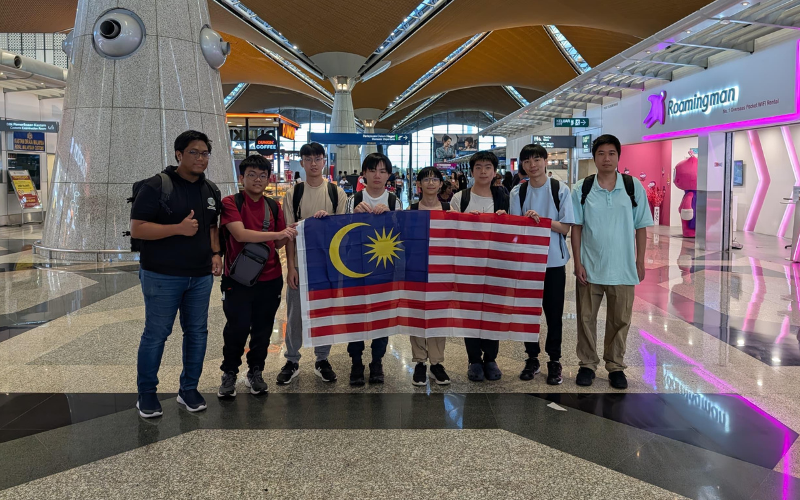
That same year, I started college studies at Taylor’s, where balancing Cambridge A Level with training became part of daily life. This often meant much of my time was spent in the library alongside friends, each working towards our own goals in long stretches of quiet focus. As the 43rd Balkan Mathematical Olympiad (2026) approached, that routine grew more purposeful. With the support of my family, friends, and Taylor’s, I was selected to represent Malaysia once again, travelling to Thessaloniki, Greece, with my teammates, carrying with me a clearer sense of the journey I was continuing.
It was near midnight when we arrived in Thessaloniki. The air was chilly, in contrast with the warm greetings of the organising committee. We were transported from the airport to our hotel in the city centre. Along the way, we caught glimpses of a city shaped by layers of Roman, Byzantine, and Ottoman history, with traces of neoclassical architecture.
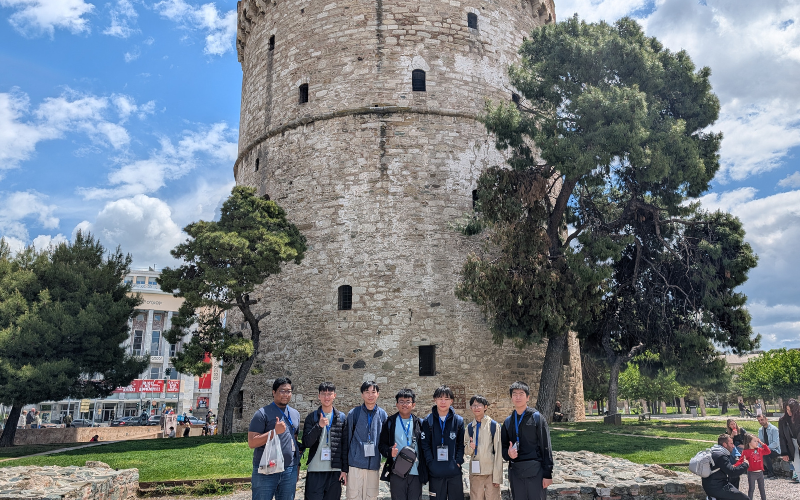
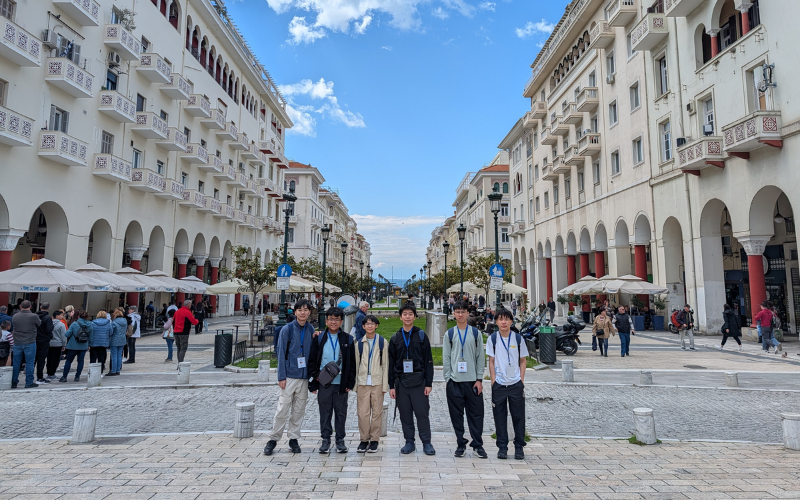
Staying at the same hotel as participants from around the world created plenty of opportunities for interaction. Over meals, I sampled Greek staples such as yoghurt, savoury pies, and local cheeses—of which there was no shortage—while speaking with others and hearing about their cultures. The opening ceremony the next day marked the official start of the competition. Afterwards, the Malaysian team and I went on a short excursion through the city centre, visiting landmarks such as the White Tower of Thessaloniki and Aristotelous Square.
By the following morning, it was time for the competition. The atmosphere in the exam hall was tense as participants took their seats: four questions, four and a half hours. To spare the technicalities, Problem 1 was surprisingly difficult for a first question. While one could make reasonable progress using inequality arguments, the real challenge came in the cases n=4 and n=5, which required a particularly tricky construction. Around one and a half to two hours had passed by this point, and I moved on to the next problem, coffee in hand.
Problem 2 was a combinatorics problem involving domino tilings and pivots. After working through several basic examples, it seemed sufficient to show a decomposition of the tiling into cycles, though my attempt at an induction argument didn’t go through. During the final hour, I turned my attention to Problem 3, a geometry problem involving a tangency condition that suggested the use of Miquel points. The last thirty minutes were spent writing up and checking my work.
After the competition, discussions quickly sprang up among participants comparing solutions and methods. I later learned that Problem 2 had a surprisingly concise solution, and that Problem 1 had been more difficult than Problem 2 for many of us. In the midst of this, however, half of the Malaysian team—including myself—had to begin packing. An unfortunate clash between the final days of the Olympiad and our AS Level examinations meant that we had to leave Greece early.
In the end, I won a Bronze medal, while Malaysia secured four Bronzes and two Silvers, placing 10th overall among the participating countries. I’d be lying if I said I wasn’t disappointed with the result, especially after preparing extensively with hopes of a Silver or Gold. At the same time, I’ve always known that nothing is guaranteed in competitions like this, particularly at the international level, where everyone has worked just as hard to be there. Still, I take some comfort in knowing that I gave it everything I had, for myself and for my country.
What stays with me most, however, isn’t the result itself, but everything that led up to it: the long hours of discussion with fellow participants, the simple satisfaction of making even the smallest progress on a seemingly impossible problem, and the shared moments when a solution finally came into focus. Through this, I’ve come to understand that there are always highs and lows in any journey. With enough effort—and a bit of luck—you eventually find your way forward; and when the way ahead isn’t clear, you pause, retrace your steps, and try again.
Beyond the competition, I’m deeply grateful to the community at BIMO, which has helped shape Malaysia’s Olympiad landscape into what it is today. My heartfelt thanks also go to my parents and to Taylor’s for their unwavering support—not only emotionally, but also in making my participation possible. To everyone who has been part of this journey, I’m truly thankful for the role you’ve played in my growth and in who I am becoming.
Looking ahead, the curiosity that first drew me to mathematics remains as strong as ever. In the face of uncertainty, I hold onto a simple principle: pessimism of the intellect, optimism of the will. While I continue my studies, I hope to pursue Pure Mathematics and Theoretical Computer Science, with the aim of contributing, even in a small way, to their ongoing exploration. For now, I remain open to where this path may lead.
to dive into what really excites you! Explore Taylor’s College at our Open Day, where hands-on learning, exciting projects, and industry exposure help you turn your interests into a career you’ll enjoy. Due to high demand for our programmes, we recommend registering early to secure your spot.