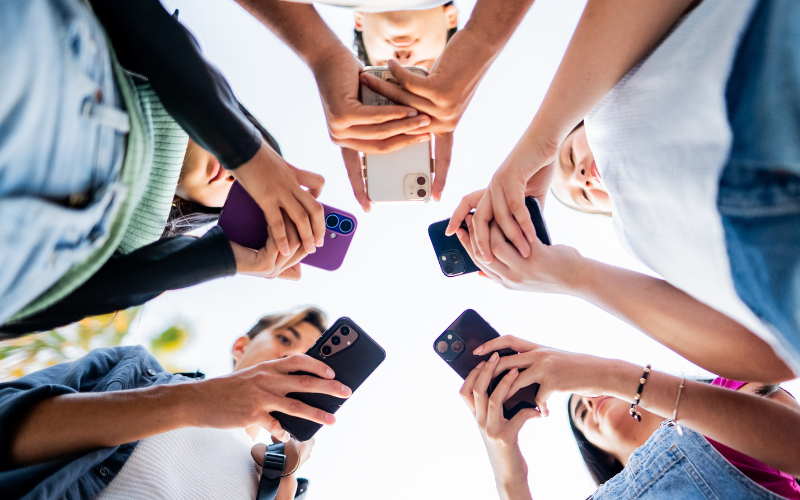

Rethink what we’ve been taught to fear and discover how smartphones are quietly influencing our attention, habits, and wellbeing.
22 May 2026
6 Min Read
Eeshma Khawar (Student Writer), Nellie Chan (Editor)
Rethink what we’ve been taught to fear and discover how smartphones are quietly influencing our attention, habits, and wellbeing.
‘Stop staring at your phone from so close.’
‘Don’t sleep next to your phone.’
‘You’re always on your phone — you’ll ruin your brain.’
Growing up, many of us must’ve heard some version of these warnings from our parents. Some were said casually, almost in passing, while others carried a stronger sense of concern.
For Gen Z, these warnings became part of the background noise of everyday life. In many ways, we’re the first generation to live two lives at once: one physical, one digital. Our smartphones are alarm clocks, classrooms, cameras, entertainment systems, social spaces, and sometimes even emotional support devices. They’re the first thing we reach for in the morning and the last thing we look at at night.
But this cycle of concern didn’t begin with smartphones. Before that, it was televisions. Before that, microwaves. Every generation inherits its own version of technological anxiety, often centred on forces we can’t see or fully understand. Seen this way, our parents’ warnings weren’t only about screen time or phone use. They were also about something more unsettling: radiation.
So, were our parents right to worry? The answer is both simpler—and more complicated—than most people think.
So far, research has found no consistent evidence that typical phone use increases cancer risk in humans. Large, long-term studies such as the Cohort Study of Mobile Phone Use and Health (COSMOS) project have not observed higher rates of brain tumours, despite these devices becoming nearly inseparable from our lives over the past two decades.
That said, research in this area isn’t straightforward. Modern smartphones have not been around long enough for scientists to study lifetime exposure properly, while technology evolves faster than research can keep pace. By the time one study wraps up its analysis of 5G phones, the world has already moved on to the next generation, 6G.
Laboratory studies offer another way of exploring the question. One widely cited set of studies by the National Toxicology Program exposed rats and mice to radiofrequency radiation for extended periods each day. Researchers observed higher rates of tumours in male rats, particularly in the heart and brain.
Before you throw your phone out the window, though, there’s an important detail.
The exposure levels used were far higher than those experienced in everyday life. What’s more, the animals were exposed in cycles totalling around nine hours a day over two years. In other words, the study was designed to test extreme conditions, not realistic patterns of phone use. That is why scientists remain cautious in drawing conclusions.
While the radiation concerns are less clear-cut than they first seem, that doesn’t mean smartphones are without very real effects.
Take sleep, for example.
Typing this at 1 a.m., I’m fully aware I’m part of the problem.
Many students scroll through TikTok, Instagram, or YouTube right before bed, only to wonder why waking up for an 8 a.m. class feels like psychological warfare. The blue light from screens mimics daylight, signalling to the brain that it’s still daytime. This suppresses melatonin, the hormone that regulates sleep.
What starts as ‘just five minutes’ of scrolling often turns into an hour-long (or longer) doomscrolling spiral.
Poor sleep doesn’t just leave us tired. It has been linked to weaker immunity, reduced cognitive performance, and poorer mental wellbeing. Suddenly, the issue is no longer about hypothetical radiation risks decades away, but habits already shaping our day-to-day lives.
Smartphones also tap directly into the brain’s reward system.
Every notification, like, or new piece of content triggers tiny bursts of dopamine—the neurotransmitter associated with pleasure and reward. Social media platforms are deliberately designed to keep users engaged for as long as possible. Infinite scroll, autoplay videos, and algorithm-driven feeds all promote consumption without us realising how much time has passed.
Over time, this constant stimulation can shorten attention spans and contribute to anxiety, burnout, and social comparison. Ironically, when we feel mentally drained, we often return to the very same devices that helped create those effects.
There are physical effects, too.
Walk around campus, and you’ll probably spot at least one person hunched over their phone like a human question mark. ‘Text neck’—the strain caused by constantly looking down at screens—has become increasingly common among younger people. Prolonged screen use can also lead to headaches, dry eyes, and eye strain.
While phones themselves are not inherently harmful, excessive screen time often encourages sedentary behaviour and reduces physical activity, increasing long-term health risks.
So, were our parents right all along? Not exactly—but they weren’t entirely wrong either.
Current research doesn’t support the idea that smartphones are secretly frying our brains with radiation. But our parents’ concern wasn’t misplaced: constant technology use does affect our attention, habits, and wellbeing in ways we’re only beginning to understand. Perhaps the worry was never invisible waves, but the very visible ways we use them.
For Gen Z, completely disconnecting from technology isn’t practical. Our education, friendships, entertainment, and even identities exist partly online. Telling young people to simply ‘put the phone down’ overlooks how deeply digital life is embedded within modern society. The real challenge today isn’t fearing technology, but learning how to live with it more intentionally.
Maybe digital hygiene matters more than digital fear: how long we spend on our phones, how often we put them down, and how much space we allow them to occupy in our minds. Because in the end, the biggest danger was never the phone itself; it was forgetting to look up from it.
Eeshma Khawar is currently pursuing a Bachelor of Biomedical Science (Honours) at Taylor’s University. Driven by scientific curiosity and a deep compassion for animal welfare, she shares her experiences to inspire mindful action and positive change.