Exams are a key part of your academic journey, marking important milestones along the way. You’ll find everything you need here—from exam schedules and venues to result release dates, grading policies, re-sits, and appeals.


Whether you're preparing for assessments, checking your results, or looking for academic support, this resource is designed to help you stay focused, confident, and ready for what’s next.


For undergraduate and postgraduate results, visit the Taylor’s University website for full details and updates.


PREPARING FOR YOUR EXAM EXTENUATING CIRCUMSTANCES AFTER YOUR EXAM RESULTS CALCULATION FREQUENTLY ASKED QUESTIONS CONTACT US

Before your exams arrive, make sure you know the key dates, understand the rules, and get your schedule in order. This section gives you the steps to prepare effectively so you can focus on doing your best on exam day.

Exam Timetable Release Date
Examination Guidelines & Rules

Your final exam timetable will be released by:

  • Week 5 – for classes running over seven (7) weeks
  • Week 9 – for classes running over fourteen (14) weeks


Your exam timetable will be available on your Taylor's Mobile App and on the Campus Central Portal.


For Cambridge A Level (CAL) and Australian Matriculation (AUSMAT) programmes, the final exam timetable will be released two (2) weeks prior to the commencement of the final examinations on the Campus Central Portal under the Announcement section.


If you notice any clashes in your exam schedule or face issues due to the timing, please reach out to us at tlsc.examscheduling@taylors.edu.my. Kindly note that having two (2) exams on the same day is not considered a scheduling conflict.


Foundation & Diploma Programmes

Foundation & Diploma Programmes

No Semester Programme Date
1

January 2025 

(7 weeks)

  • Taylor's College Foundation
  • Taylor's College Diploma
3 February 2025
2

February 2025 

(7 weeks)

Taylor's College Foundation 28 February 2025
3

April 2025 

(14 weeks)

  • Taylor's College Foundation
  • Taylor's College Diploma
9 June 2025
4

May 2025

(12 weeks)

Taylor's College Intensive English N/A
5

August 2025 

(14 weeks)

  • Taylor's College Foundation
  • Taylor's College Diploma
21 October 2025
6

September 2025 

(12 weeks)

Taylor's College Intensive English N/A
7

January 2026 

(12 weeks)

Taylor's College Intensive English  N/A
  • Note: The dates above are subject to change.

As a student, you are required to read, understand and abide by the following rules and regulations. We expect all students to uphold the highest standards of integrity and conduct throughout the examination period. Any breach of these rules may result in serious consequences—including disqualification, suspension from future exams, or expulsion. Cheating in any form will not be tolerated and may lead to a zero mark or termination from Taylor's.


Note: The examination rules and regulations apply to all Taylor's programmes (except for Cambridge A Level, AUSMAT and professional courses). For these, please refer to the specific guidelines below:

Before the Examination

Before the Examination

1. Schedule Awareness and Reporting Conflicts
  • Know the date, time and venue for each of your examination.
  • Report any timetable conflict/clashes to tlsc.examscheduling@taylors.edu.my by the given deadline.
  • Do not arrange ceremonies, vacations/travel or special occasions which coincide with the exam periods. These will not be accepted as valid grounds for an alternative examination.


2. Dress Code and Personal Appearance
  • Dress in decent, neat and clean clothing. The following are not allowed: shorts, singlets, spaghetti straps, off-shoulder tops, tubes, clothes revealing undergarments, excessively short skirts, transparent garments, low necklines, exposed midriff or bareback.
  • Taylor’s reserves the right to determine the appropriateness of your attire.
  • Caps are not permitted in the examination hall unless supported by a valid medical reason.


3. Arriving and Entering the Exam Venue
  • Be at your designated venue at least 15 minutes before the start of the examination.
  • You are not permitted to enter the exam room until instructed by the invigilator.
  • If you arrive late, report to the invigilator. No extra time will be given.
  • You will not be allowed to enter the venue 30 minutes after the exam has started.


4. Belongings and Materials
  • All electronic devices (phones, smartwatches, gadgets) must be switched off and placed face-down under your chair.
    • Students are responsible for their valuable items.
    • Place all textbooks, notes, bags and belongings at the designated area (usually in front of the venue).
  • You may bring only permitted items: pens, pencils, erasers, rulers, and approved instruments.
    • Pencil cases must be transparent and placed on the floor.
    • Use blue or black ink for writing.
    • Use pencil (BB or 2B) for multiple-choice papers.
    • Coloured pencils and ink are only allowed for diagrams, maps, and charts.
  • Borrowing of any items during the exam is strictly prohibited.
  • You may only use a non-programmable, silent calculator. Place its cover face-down under your chair. No unauthorised materials allowed.
  • Dictionaries and spell-checkers (including electronic ones) are not allowed unless officially approved.


5. Identity Verification
  • You must bring two (2) of the following documents:
    • Taylor’s Student ID
    • MyKad (for Malaysians and Permanent Residents)
    • i-Kad or passport (for international students)
    • Driver’s license with photo
  • If you do not have these, you must obtain a Temporary Identification for Admissions to Exams Form from Campus Central, Block A, Level 2.


6. Unable to Attend
  1.  

    If you are unable to attend an examination due to severe illness, submit the Extenuating Circumstances e-Form via the Campus Central portal within three (3) working days from the date of the exam. You can read more on this in the following section.

During the Examination

During the Examination

1. General Conduct and Instructions
  • Remain quiet at all times while in the examination room.
  • Follow all instructions given by the invigilator.
  • Sign the Attendance Slip placed on your desk.
  • Place your identification documents at the top left-hand corner of your desk for verification.
  • Read all instructions printed on the question paper and/or answer booklet carefully.
  • Fill in all required details on the answer booklet/paper and question paper (if applicable).
  • Do your rough work only on the official examination stationery provided.


2. Reporting Issues
  • Inform the invigilator immediately if:
    • You believe you have been given the wrong question paper.
    • The question paper is incomplete or badly printed.
    • You did not receive all the materials listed on the front page of the paper.
  • If you have a problem or require additional materials (e.g. extra paper), raise your hand to alert the invigilator.
  • You must not ask for — and will not be given — any explanation on the examination questions.


3. Prohibited Conduct


You are strictly prohibited from the following during the examination:

  • Possessing any unauthorised materials:
    • Books, notes, blank paper, or any aids not issued for that particular exam.
  • Engaging in academic misconduct:
    • Giving or receiving help from another candidate, directly or indirectly.
    • Sharing writing tools or any other items.
  • Disruptive behaviour:
    • Talking, moving unnecessarily, or looking around.
    • Breaching good order or exam room discipline.


4. Leaving the Exam Venue
  • You may not leave the examination venue:
    • Within the first 30 minutes of the examination.
    • During the last 15 minutes of the examination.
  • If you finish early (after the first 30 minutes and before the last 15 minutes), you may leave with permission, but you must not take the question paper or any other exam materials with you.


5. Toilet Use
  • Toilet use is discouraged during the exam.
  • If needed:
    • Raise your hand and request permission from the invigilator.
    • You will be accompanied to the toilet.
    • You must remove your jacket and ensure your pockets are empty.


6. Emergencies or Disruptions
  • In the event of a temporary stoppage or relocation of the exam:
    • Remain quiet at all times.
    • Follow all instructions from the invigilator.
  • Any stoppage time will be recorded and added to your exam duration accordingly.


7. Consumption for Food and Drinks
  • You are allowed to bring drinking water into the exam venue.
  • If you have a medical condition that requires you to eat during the exam, you must obtain prior permission from the Chief Invigilator.
End of the Examination

End of the Examination

Ending the Examination


  • If you have used more than one answer booklet and/or loose sheets:
    • Place them in the correct order before the exam ends.
    • Fill in all required information on each booklet or sheet before the invigilator announces the end of the examination.
    • No extra time will be given after the instruction to stop writing has been announced.
    • Insert all additional booklets or loose sheets at the back of the first booklet.
    • Fasten all answer sheets securely using the string provided.
  • You must remain seated until the invigilator instructs you to leave the room.

  • You are not allowed to take any of the following out of the examination room:

    • Examination stationery (used or unused)

    • Rough work

    • Any other materials provided for the examination

    • Question papers, unless explicitly permitted by the invigilator

​Special Examination Conditions for Student with Special Needs

​Special Examination Conditions for Student with Special Needs

Special examination conditions may be provided to students with special needs. These may include an extension of examination time or other approved arrangements to support students with special needs.


Where the use of a dictionary is permitted during an examination, please ensure that it does not contain any handwritten notes or annotations. The use of electronic dictionaries is strictly not allowed.


Students who require special arrangements for final examinations due to a temporary or permanent condition / special needs must consult the Centre for Counselling Services (CCS) at Block A, Level 2 for further assessment and approval.

If unexpected events affect your ability to perform in an assessment, it’s important to know what steps to take. This section guides you through what qualifies as extenuating circumstances, how to apply for consideration, and the evidence you’ll need — so you can focus on getting the support you need when it matters most.

Understanding Extenuating Circumstances
Application and Evidence Requirements

Extenuating circumstances refer to unexpected and serious events that affect your ability to perform in assessments. These typically:

  • Prevent you from performing at your usual level in an exam or assessment
  • Are severe and exceptional
  • Are unforeseen or unavoidable
  • Occur close to the affected assessment or exam date


*Application for Consideration of Extenuating Circumstances is only applicable to Taylor's College programmes and does not apply to Cambridge A Level (CAL), Australian Matriculation (AUSMAT) or professional courses. If you’re in one of these programmes, please reach out to your Programme Director for guidance.

Circumstances That Are Unlikely to Be Accepted
 
1. Medical ground
  • Medical ground or other special needs that have been accommodated, such as poor eyesight, Parkinson or speech difficulty.
  • A short-term problem or illness which has occurred during the year and which is not deemed to have had an overall effect on your performance.


2. ​Emotional and psychological ground
  • General pressure of work (this is not taken to be circumstances beyond your control, as you are expected to plan your work schedule).
  • Normal examination stress or anxiety experienced during revision or the assessment period (unless corroborated by medical evidence as a chronic condition and undergoing treatment).


3.  Situational factors/others​
  • ​​​Non-serious domestic or personal disruptions such as moving house or change of employment.
  • Pre-planned events which could have been anticipated and not unique in nature, such as travel plans, annual activities, religious holidays or festivals, which are usually known in advance.
  • Study-related circumstances such as equipment failure, including computing/printer difficulties (unless they occur during the examination itself), failure to have taken back-up copies of original work which have been stolen or corrupted, bunching of deadlines/ examinations, missing books, poor time management or taking the wrong examination.
  • Excessive demands on time or pressure of your employment, which could have been anticipated.
  • Financial constraints are commonly experienced by students.
  • Missing an examination because you have misread the timetable or overslept.
  • Late for examination because of a traffic jam, whereby you should have allocated additional travelling time in anticipation of any unforeseeable circumstances.
  • Time constraints where you have more than one examination on the same day or all assignments submission deadlines on consecutive days within the same week (unless you were already suffering from illness or injury).

How the College Can Support You

How the College Can Support You

If you are experiencing extenuating circumstances, the college offers several support options. You may submit the Extenuating Circumstances e-Form for the following purposes:


1. Request an Alternative Examination
  • If you are unable to attend a final examination due to extenuating circumstances.
  • Submit the form within three (3) working days from the date of the missed examination.


2. Apply for an Assignment Deadline Extension
  • If you are unable to meet an assignment (final assessment) deadline.
  • Submit the form within three (3) working days from the date of the assignment deadline.


3. Request Consideration for Impacted Performance
  • If your performance in an exam or assessment was negatively affected.
  • Submit the form within three (3) working days of the final examination date or assessment due date.

Missed the application deadline?

Late submissions may be accepted within three (3) working days from the last day of the final examination period, provided you include a valid written explanation and supporting evidence. Applications submitted beyond this timeframe will not be accepted.

Important Considerations

Important Considerations

  • Each application is reviewed and decided by the Head of School.
  • You can only take one alternative exam per module per semester:
    • If you miss the alternative exam, you must repeat the module in the following semester.
    • Students who miss a re-sit opportunity will not be granted another and may have to repeat the module.
  • No re-sit exams will be granted to students who attend an alternative exam but fail with a marginal grade.
  • Submitting evidence does not guarantee approval — further documentation may be requested.
  • Submission of falsified evidence (e.g. medical certificates) is considered disciplinary misconduct.
Hearing Outcome

Hearing Outcome

You will be notified of the outcome of your application according to the following timelines:​

  • Applications submitted at least one (1) week before the final exam period* begins: Outcomes will be released before the exam period begins.​
  • Applications submitted during the final exam period*: Outcomes will be released within five (5) working days after the exam period ends.


*Refer to the Academic Calendar for the final exam period


Evidence Requirements

Evidence Requirements

To support your application for extenuating circumstances, your documents (e.g. medical certificates, reports, or letters) must:

  • be on official letterhead (if applicable), and signed and dated,
  • indicate that the situation was unexpected and beyond your control,
  • summarise the nature and duration of the condition or situation,
  • clearly explain how the circumstance impacted your ability to sit for the final exam or complete your assessment, and
  • be in English or accompanied by an authorised translation.

Please note that submitting supporting documents does not guarantee approval of your request. Every application, including the evidence provided, will be thoroughly reviewed to determine eligibility. Additional documentation may be requested where necessary.


The submission of falsified or misleading documents will be treated as disciplinary misconduct.


Note: Overseas documents are no longer accepted due to verification issues.

Once your exams are over, there are a few important steps to follow — from checking your results to arranging re-sits, repeating modules, or requesting transcripts. Scroll through the tabs to explore each section and take the right actions to stay on track with your academic journey.

Release of Results Dates
Review of Examination Results
Re-sit Examinations
Repeat Module
Alternative / Special Assessment
Re-sit or Repeat Passed Modules (For Foundation)
Transcript

Examination results will be released as final grades only and published on the student portal at the end of each semester. Please note that results will not be shared via telephone, fax, or email, including to parents.

Foundation & Diploma Programmes

Foundation & Diploma Programmes

No Semester Programme ​Release of ​Final Examinations Results Dates​ Release of Re-sit Examinations Results Dates
1

January 2025

(7 weeks)

  • Taylor's College Foundation
  • Taylor's College Diploma
14 March 2025 28 March 2025
3

February 2025

(7 weeks)

Taylor's College Foundation

4 April 2025 18 April 2025
6

April 2025

(14 weeks)

  • Taylor's College Foundation
  • Taylor's College Diploma

8 August 2025​

22 August 2025​

11

May 2025

(12 weeks)

Taylor's College Intensive English

8 August 2025​

N/A
14

August 2025

(14 weeks)

  • Taylor's College Foundation
  • Taylor's College Diploma

2 January 2026

26 January 2026​

16

September 2025

(12 weeks)

Taylor's College Intensive English

19 December 2025​

N/A​

19

January 2026

(12 weeks)

Taylor's College Intensive English  3 April 2026 N/A
Internship

Internship

Your results will be released at the end of each semester based on the official schedule. Please refer to the details below.


The release of Internship results may be delayed if there are issues such as pending internship placements, late submission of supervisor reports, or delays in external supervisor feedback. The information below is accurate as of 13 January 2025, but may be updated from time to time depending on these factors.

No Programme Release of Internship Results Dates
1 ​Diploma in Information Technology​ | Jan 2025 11 April 2025
2 Diploma in Information Technology​ | Apr 2025 8 August 2025
3 Diploma in Information Technology​ | Aug 2025 2 January 2026
4 Diploma in Interior Design | Aug 2024 24 January 2025
5 Diploma in Interior Design | Apr 2025 4 September 2025
6 Diploma in Interior Design | Aug 2025 26 January 2026
7 Diploma in Early Childhood Education | Apr 2025 22 August 2025
8 Diploma in Early Childhood Education | Aug 2025 26 January 2026
  • Note: The dates above are subject to change.

Overview & Eligibility

Overview & Eligibility

A review of examination results means that there will be a confirmation to ensure all sections of the examination are marked appropriately with a correct total marks given. This may include a re-mark of the examination paper, if deemed necessary by the Head of School.


You may request a review of your final examination result if you believe there has been a possible error in the grade computation. Please note that requests based solely on dissatisfaction with your result will not be accepted.


*Review of examination results is only applicable to Taylor's College programmes and does not apply to CAL, AUSMAT, or professional courses.

What to Prepare

What to Prepare

Before applying, make sure you have the following:

  • A clear explanation of why you believe a review is justified
  • Any relevant supporting documents (if applicable) to back up your claim

Ensuring that your submission is complete and well-documented will help prevent unnecessary delays.

When & How to Apply

When & How to Apply

Applications must be submitted within three (3) working days from the official result release date. To apply:

Only complete applications submitted on time will be processed.

Fees

Fees

A processing fee is applicable for each request for review.

  • Undergraduate programmes: MYR 50*


*With an additional of 6% SST for international students

Outcome

Outcome

You will be notified of the review outcome within five (5) working days via your Taylor’s email. 


Please be aware that the outcome of the review will be considered as the final result. This means that your final mark could end up being higher, lower, or remain the same as before. In other words, the revised results could potentially be lower than your original mark.​


Payment will be refunded if your review of results is successful and leads to a positive change of grade.


Overview & Eligibility

Overview & Eligibility

If you are eligible for a re-sit or supplementary examination, you need to pay:

  •  

Foundation & Diploma programmes

MYR 150* per module

*With an additional of 6% SST for international students


The re-sit examination fee will be reflected in your Statement of Account one day after the release of results and must be paid before undertaking the re-sit. Both re-sit examination and re-assessment fees paid are non-refundable


Re-sit examinations or reassessments of projects are only granted to students who have been awarded to do so by the School Board of Examiners. If you choose not to re-sit or to be reassessed, you must repeat the module.

Payment Instructions

Payment Instructions

To make payment, here's what you need to do:
  • Log in to the Campus Central Portal or Taylor's Mobile app
  • Go to the Current Semester's Fee to view the outstanding amount
  • Pay using Taylor’s Pay / Flywire (international payment)

If you prefer not to combine with your next semester fee:

  • Click "Other Amount"
  • Enter the desired payment amount

Note: All payments are non-refundable.

Types of Re-sits & Actions Required

Types of Re-sits & Actions Required

Re-sit examinations or reassessment of projects are only granted to students who have been awarded to do so by the School Board of Examiners. If you choose not to take the re-sit examination or do the reassessment, you must then repeat the module.

1

Re-sit / Re-sit Final Examination

You are required to re-sit the final examination component of the module.

2

Re-submission

You are required to resubmit the assessment component (for modules without final exams).

Contact your module lecturer to make the necessary arrangements before the resubmission.

3

Re-sit Coursework

You are required to re-submit the coursework component(s). Contact your module lecturer before the re-sit examination week.

4

Re-sit All Components

You are required to re-submit the coursework component(s) and re-sit the final examination.
Contact your module lecturer to make arrangements before the re-sit week.

Release of Re-sit Exam Timetable

Release of Re-sit Exam Timetable

No Semester Programmes ​Release Date
1 January 2025
  • Taylor's College Foundation
  • Taylor's College Diploma

18 March 2025

2 ​​​​​​February 2025​
Taylor's College Foundation
7 April 2025
3 April 2025
  • Taylor's College Foundation
  • Taylor's College Diploma

11 August 2025

4 August 2025
  • Taylor's College Foundation
  • Taylor's College Diploma

5 January 2026

Note: The dates above are subject to change.

Applicable for Taylor's College homegrown programmes

When and What to Expect When Repeating a Module

When and What to Expect When Repeating a Module

If you’ve failed any module(s), you must add the failed module(s) during the Module Add/Drop (Tier 2) period, which opens one (1) week before the semester begins. You may add or drop via here.


Repeating a module means:

  • You’ll need to attend classes and retake all assessments.
  • If the failed module is an elective, you may take a replacement module instead—provided it’s within the maximum completion time of your programme.
Attempts and Outcomes

Attempts and Outcomes

No Attempt What Happens
1 1st Attempt (Fail) Required to repeat the module at the earliest possible offering.
2 2nd Attempt (Repeat) Repeat the module again. If you fail this attempt, you will only have one final opportunity.
3 3rd Attempt (Final Repeat) This is your last chance. If you fail again, you will be excluded from the programme.
4 Failed 3rd Attempt If you fail the module after three (3) total attempts including two (2) repeats without considering re-sit opportunity, you will be excluded from the programme.

An alternative assessment may be set under special circumstances, if recommended by the School Board of Examiners.


The Board may recommend a special assessment, which may include a supplementary examination if you fail in only one module in the final examination and the module is not being offered in the graduating semester of the programme.


No further re-sit/supplementary examination will be allowed after you have sat for the alternative final examination.

As a Foundation student, you may re-sit or repeat a module you have already passed if you want to improve your grade and CGPA. This can help you meet the entry requirements of your chosen degree programme. You must apply within two (2) working days after your results are released.

Option 1: Re-sit a Passed Module

Option 1: Re-sit a Passed Module

  • You may re-sit a passed module once only.
  • Only the better grade (from your re-sit or your original result) will be recorded in your transcript and used for CGPA calculation.
  • Once your re-sit is registered (within 3 working days of submission), you must:
    • pay the re-sit exam fee,
    • check the re-sit exam schedule on the portal, and
    • sit for the re-sit exam.    
  • Your re-sit grade will only be accepted if it meets the degree entry requirements (including those set by other universities and professional bodies). If not, you may consider repeating the module in an extended semester. 
  • If you choose to repeat the module, you should then complete the Application to Repeat Passed Module(s) form, within two (2) working days of release of re-sit results. 
Option 2: Repeat a Passed Module

Option 2: Repeat a Passed Module

To be eligible, you must:

  • not have attempted the module three (3) times (excluding re-sits),
  • not have exceeded the programme’s maximum completion time (2 years), and
  • apply within two (2) working days of release of results.


Important to Know:

  • You may only repeat once for each passed module.
  • The best grade (repeat or original) will be kept in your transcript and used for CGPA calculation.
  • You must consult your Programme Director on module offering before applying.
  • If approved, the module will be added for you manually within one (1) working day.
  • The repeated grade is also subject to the degree programme’s entry requirements (including those of other universities and professional bodies).
How to Apply

How to Apply

You must apply within two (2) working days of release of results. 

Re-sit Passed Module

Complete the application form and attach your parent/guardian consent letter and any supporting documents (if required)

Repeat Passed Module

Complete the application form and attach your parent/guardian consent letter and any supporting documents (if required)

An academic transcript is an official record of your academic results — it shows the modules you’ve completed (including passes or fails) throughout your time at Taylor’s. Do note that any modules completed before the release of results won’t appear in your transcript at the time of request.

1
Requesting a Partial Transcript (Current Students)


You can request a partial transcript (for ongoing studies) and receive it in PDF format via your Taylor’s student email — usually within 12 hours, free of charge.

2
Receiving Your Official Transcript (Completed Students)


If you’ve completed your programme, your Official Academic Transcript and Letter of Award Conferment (LOAC) / Certificate of Completion will be issued after the Academic Board approval, which may take between two (2) weeks and up to three (3) months after the release of your final exam results. 


You will be informed via your personal and Taylor's email when:

  • for Diploma students: your transcript and LOAC are available for download on the Campus Central Portal.
  • for Foundation students: your transcript and Certificate of Completion are ready for collection.

Learn how your academic performance is assessed — from grading standards and GPA calculations to weighted scores, award classifications, and programme learning outcomes. Use the tabs below to explore each area and understand how your results are determined.

Grading Standard
Calculation of GPA, CGPA
Calculation of WGPA and WCGPA
Awards Classification
Programme Learning Outcome Attainment

Grading Standard refers to the system or criteria used to evaluate and assign grades to students' academic work. It outlines how marks or percentages translate into letter grades, grade points, or classifications (e.g., excellent, pass, fail).

Foundation & Diploma

Foundation & Diploma

Your official Taylor's transcript will reflect grades using the following standard:

Excellent

Evidence of original thinking; demonstrated outstanding capacity to apply, analyze synthesise and evaluate information; outstanding grasp of subject matter; evidence of outstanding command of the relevant knowledge base.​

 No Grade Marks (%) Grade Points
1 A 80 - 100 4.00
Very Good

Evidence of some original thinking; demonstrated very good capacity to apply, analyse, synthesise and evaluate information; very good grasp of subject matter; and evidence of very good command of the relevant knowledge base. ​​

No Grade Marks (%) Grade Points
1 A- 75 - 79 3.67
Good​

Demonstrate good capacity to apply, analyse, synthesise and evaluate information, a good grasp of subject matter, and evidence of good command of the relevant knowledge base.​

No Grade Marks (%) Grade Points
1

B+

70 - 74​

3.33

2

B

65 - 69

​3.00

Pass

​Demonstrate adequate capacity to apply, analyse and synthesise information, adequate grasp of subject matter, and evidence of adequate command of the relevant knowledge base.​​

No Grade Marks (%) Grade Points
1

B-

60 - 64​

2.67

2

C+

55 - 59

2.33

3

C

50 - 54

2.00​​

​Marginal Fail​

​​Demonstrate inadequate capacity to apply and analyse information, insufficient grasp of subject matter, and evidence of limited command of the relevant knowledge base.​

No Grade Marks (%) Grade Points
1

D+

47 - 49​

1.67

2

D

44 - 46

1.33​

3

D-

40 - 43

1.00

Fail

Demonstrated very weak capacity to apply and analyse information, very weak grasp of subject matter, and evidence of very weak command of the relevant knowledge base.​

No Grade Marks (%) Grade Points
1

F

0 - 39

0.00

For reference

  • WD (Withdrawn)  - Withdrawn from a module before census date, typically mid-semester*[Refer to Description 1].
  • F (W) (Fail) - Withdrawn from a module after the census date, typically mid-semester** [Refer to Description 2].
  • IN (Incomplete) An interim notation is given for a module where a student has not completed certain requirements with a valid reason, or it is not possible to finalise the grade by the published deadline.​
  • IP (In Progress) - An Interim notation used for a module that continued for more than one semester. An “IP” grade carries with it no credit or grade until a regular grade is assigned. ​
  • P (Pass) - Given for satisfactory completion of a non-graded module. It is a module that is ‘graded’ with ‘pass’ or ‘fail’ without any grades such as Grade A, B, C or D.
  • AU (Audit​) - Given for a module where attendance is for information only without earning academic credit.​

*Description 1:

  • Week 3 to Week 7 (inclusive) for the long semester, or Week 3 to Week 5 (inclusive) for the short semester. A short semester is less than twelve (12) weeks. Not applicable for audit and internship.​
  • For a module that is to be completed in more than one (1) semester, WD will be awarded if the student withdraws the module before the final semester of the module's duration.​
  • WD will not be counted as an attempt and shall not be included in GPA/CGPA calculation.​

** Description 2: 

  • After Week 7 for the long semester, or after Week 5 for the short semester. A short semester is less than twelve (12) weeks. Not applicable for audit and internship.​​
  • For a module that is to be completed in more than one (1) semester, F(W) will be awarded if the student withdraws during the final semester of the module's duration according to the census date.
  • F(W) will be counted as an attempt and shall be included in GPA/CGPA calculation.​


GPA: Foundation & Diploma

GPA: Foundation & Diploma

calculation of GPA


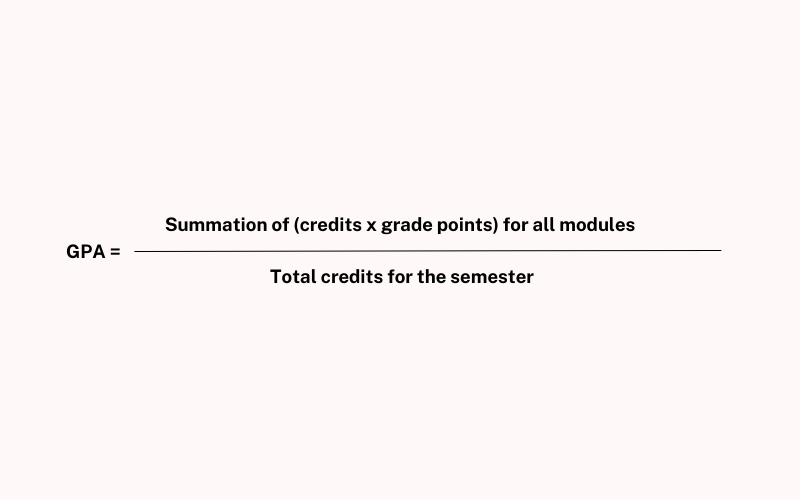
Each semester, your performance is measured using the Grade Point Average (GPA) — a numerical summary of how well you’ve done in your modules for that semester.


Here’s an example of how your GPA is calculated based on your semester results, using the formula shown.

No Module Credit Grade Grade Point Total Grade Point
1 ACC60104​
4​
A-
3.67
14.68
2 COM61604
4​
A
4.00​
16.00​
3 ECN60104​
4​
B​+
3.33​
13.32
4 FIN60104
4​
B-
2.67
10.68
5 MGT60104​
4​
A​
4.00
16.00

Total Credit: 20

Total Grade Points: 70.68

GPA = 70.68 ÷ 20 = 3.53

CGPA: Foundation & Diploma

CGPA: Foundation & Diploma

calculation of CGPA


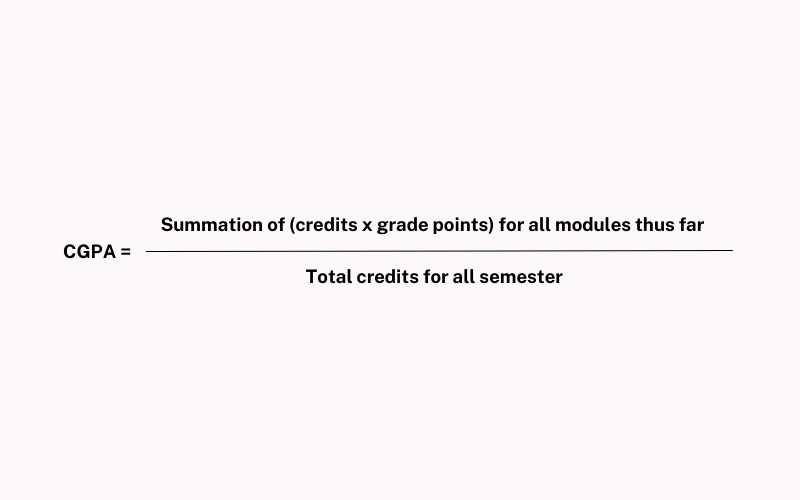
Your CGPA shows your overall academic performance across all semesters throughout your study duration.


Effective from the March 2018 intake, all modules attempted are considered for CGPA calculation. When the number of credits attempted (including electives) exceeds the minimum graduating credits, the credits and modules selected for each component are based on the best possible outcome or the highest grade achieved. As a result, a failed elective may not be included in the CGPA, and a student may not need to repeat it as long as the graduation criteria are fulfilled. The calculation follows the formula shown.

No Module Code Category Credit Load Grade Grade Points Total Grade Points Selected for CGPA Remarks
1 ADV60104 Compulsory 4 A-
3.67
14.68​​​ Yes -
2 MKT60204 Compulsory  4 A
4.00​ 16.00 Yes -
3 CSC60104 Elective 4 B+
3.33
13.32​ No To complete one module
4 CSC60404 Elective 4 A​
4.00
16.00 Yes
5 ADV60404​ Elective 4 B
3.00
12.00 Yes To complete two module
6 ADV60504 Elective 4 B-​
2.67
10.68 Yes
7 ADV60604 Elective 4 D
1.33 
5.32 No


Total Credit Load: 20

Total Grade Points: 69.36


CGPA = 69.36 ÷ 20 = 3.46

Note:

​'Mata Pelajaran Pengajian Umum' (General Studies Subjects or MPU) modules are subject to an assessment and form part of the minimum graduating credits as well as the CGPA calculation. Students are required to pass all the required MPU modules.

  • Effective 2020 intakes onwards, grades obtained for U1 to U4 modules (except BKA module) are included in computing the student’s GPA and CGPA.​
  • Prior to 2020 intakes, U1 modules are excluded from the GPA and CGPA calculation.
  • For BKA module,
    • From 2018 intakes onwards, for programmes where U2 Life Skills module is compulsory, and students may take BKA module as additional U2 module, the BKA module is excluded from the GPA and CGPA calculation.​
    • From 2018 intakes until the policy stated in note 1(iii) (a) above is implemented, for programmes where students are allowed to take either U2 Life Skills module or BKA module, the module completed by the student will be used for GPA and CGPA calculation. In the event students have taken both modules, the best grade between the two modules will be selected for GPA and CGPA calculation. This is applicable to Diploma programmes prior to implementation of the Taylor’s Curriculum Framework (TCF).​

WGPA: Diploma

WGPA: Diploma

calculation of WGPA


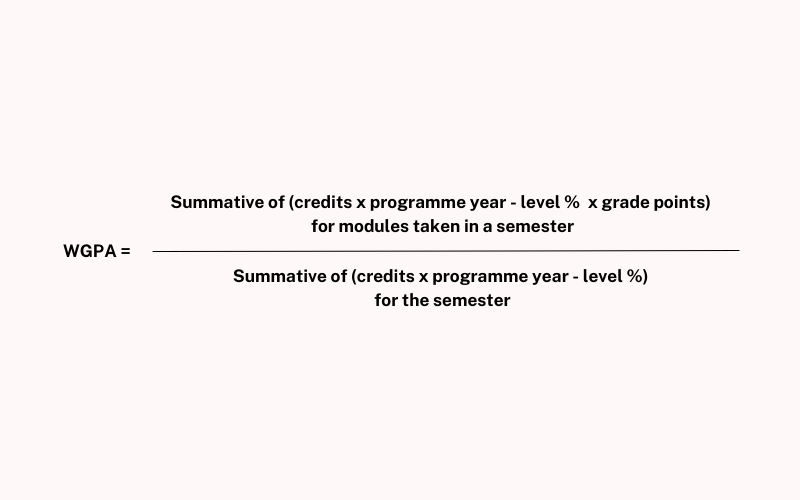
From January 2023 intakes onwards, your performance for a semester is calculated using Weighted GPA (WGPA). When a student from a 2-year or 2.5-year programme takes a Year-2 module, the Year-2 module carries the same weightage as a Year-2.5 module in the WGPA and WCGPA calculation. The calculation follows the formula shown.

WCGPA: Diploma

WCGPA: Diploma

calculation of WCGPA


From January 2023 intakes onwards, your performance over the entire duration of your studies is calculated using Weighted CGPA (WCGPA), based on 20:30:50 (2-year and 2.5-year programme) weightage in percentage over year-levels of modules in a programme.


All modules attempted are considered for WCGPA calculation. When the number of credits earned through the elective module exceeds the minimum credit required for each component of the programme structure, the selection used for WCGPA calculation is based on the highest grade achieved.


The following are examples of calculations using modules at different year levels with varying year-level weightages. Each example is derived using the formula shown.

Table 1: Modules from Year 1 Only


Total Weighted Credit = 3.20
Total Weighted Grade Points = 6.93


WGPA = 6.93 ÷ 3.20 = 2.17

No Year + Module Weightage (%) Credit Grade Grade Points

​Credit x Programme

Year-level %

​Credit x Programme

Year-level​ % x Grade Point

1 Year 1, A 40 4 C 2.00 1.6
3.20
2 Year 1, B 40 4 C+ 2.33 ​1.6
3.73
Table 2: Modules from Year 1 + 2


Total Weighted Credit = 8.00
Total Weighted Grade Points = 21.33


WGPA = 21.33 ÷ 8.00 = 2.67

No Year + Module Weightage (%) Credit Grade Grade Points

​Credit x Programme

Year-level %

​Credit x Programme

Year-level​ % x Grade Point

1 Year 1, A 40 4 C 2.00 1.6
3.20
2 Year 1, B 40 4 C+ 2.33 ​1.6
3.73
3 Year 2, C 60 4​ B-​ ​2.67
2.4
6.41
4 Year 2, D 60 4​ ​B+
​3.33
2.4
7.99
Notes:


General Studies (MPU) also known as Mata Pelajaran Pengajian Umum modules are compulsory and must be passed to meet graduation requirements. You are required to pass all the required MPU modules. However, if you are a Postgraduate student, this is not applicable to you. 


Whether they are included in your GPA or CGPA depends on your intake and programme type:

  • For intakes before 2020, U1 modules are excluded from the GPA and CGPA calculation.
  • For 2020 intakes and beyond, all MPU modules (U1 to U4) are included in GPA and CGPA calculations except BKA*. 
For BKA Module, depending on your programme structure, it may or may not count towards your GPA/CGPA.
  • If U2 Life Skills is compulsory, you may take BKA as an additional module, but it will be excluded in GPA and CGPA calculation.
  • If you're allowed to choose between U2 Life Skills or BKA, only one (1) module (whichever you completed) will count. If both were taken, the higher grade will be used for GPA and CGPA. 
  • This only applies to Diploma programmes before the Taylor’s Curriculum Framework (TCF).

Award Classification refers to the system used by a college to determine the class or level of a qualification awarded to a student upon graduation, based on their overall academic performance (typically CGPA or WCGPA).

Foundation & Diploma

Foundation & Diploma

The final CGPA or WCGPA, after completing all required credits for graduation, determines the award classification as follows:

No Award Classification

WCGPA Required For Taylor’s Diploma

(Effective from January 2023 intake)

CGPA Required For Taylor’s Diploma (Before January 2023 intake) and Foundation
1 High Distinction 3.67 to 4.00 3.67 to 4.00
2 Distinction 3.33 to 3.66

3.33 to 3.66​

3 Merit 2.67 to 3.32

2.67 to 3.32

4 Pass  2.00 to 2.66

2.00 to 2.66​

5 No Award Below 2.00

Below 2.00​

Criteria

Criteria

Note : Applicable to Diploma programme only


Programme Learning Outcome (PLO) Attainment gives you an overview of how you’re progressing in achieving the learning outcomes of your programme. It also provides insight into your development of Taylor’s Graduate Capabilities (TGC).


PLO attainment is calculated based on the following criteria:

  • The same year-level weightage used in the Weighted GPA (WGPA) calculation is applied for PLO WGPA, and the same applies to WCGPA and PLO WCGPA.
  • All core modules (primary major) and University compulsory modules are included, except:
    • Modules with pass/fail grading
    • BKA module
    • Complementary study modules
  • If your module marks were moderated or capped (e.g. after a re-sit), and specific assessment task marks weren’t adjusted, then the original (unmoderated or uncapped) task marks will be used for PLO calculation.
  • Modules completed at partner institutions without component-level breakdowns are not included in PLO attainment reporting.
  • For 2020 intakes onwards, PLO attainment for re-sits is calculated using the re-sit results combined with the original results from other assessment tasks.
Calculation

Calculation

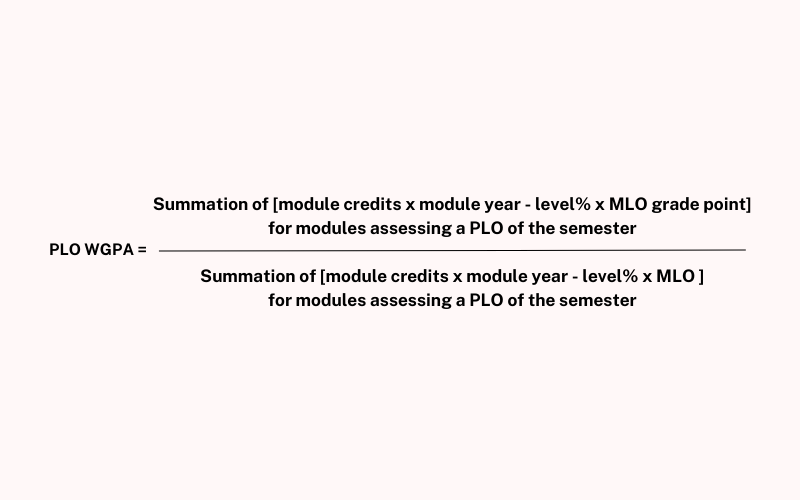
PLO Weighted Grade Point Average (WGPA) Calculation

The PLO Weighted GPA (PLO WGPA) is calculated using the formula below:

PLO WGPA Calculation

For modules assessing a PLO within the semester

PLO Weighted Cumulative Grade Point Average (WCGPA) Calculation

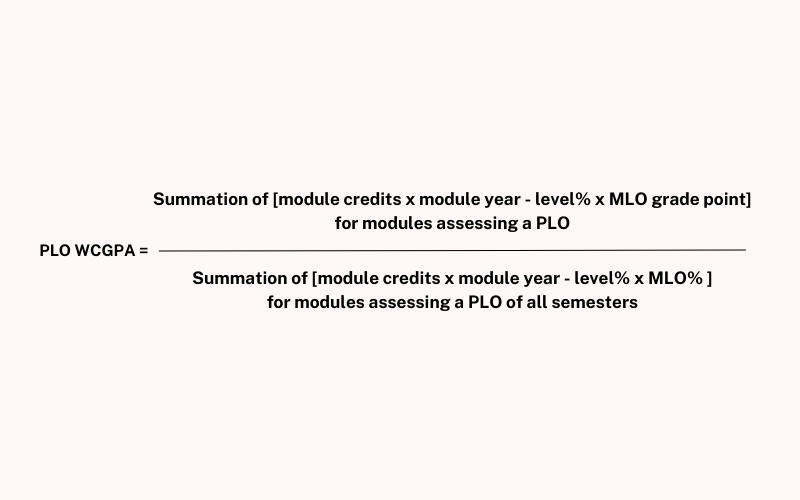
The PLO Weighted CGPA (PLO WCGPA) is calculated using the formula below:​

PLO WCGPA Calculation

For modules assessing a PLO of all semesters

PREPARING FOR YOUR EXAM
EXTENUATING CIRCUMSTANCES
Review of Exam Results
Re-sit Examinations
Transcript

When will the official exam timetable be released?

When will the official exam timetable be released?

Your final exam timetable will be released by:

  • Week 5 – for classes running over seven (7) weeks (short semester)
  • Week 9 – for classes running over fourteen (14) weeks (long semester)


You may check the "Exam Timetable Release Date" section for the expected release date of the exam timetable, which will be made available on your Taylor's Mobile App and on the Campus Central Portal. 

Where can I view or download my exam timetable?

Where can I view or download my exam timetable?

You can view your exam timetable on your Taylor's Mobile App and on the Campus Central Portal. 

How do I know if I’m registered for the exam?

How do I know if I’m registered for the exam?

If your module is part of your current semester enrolment, you are automatically registered for the exam.

Can I request to change my exam date or time?

Can I request to change my exam date or time?

Exam dates and times are fixed and cannot be changed. Please plan your schedule accordingly.

What items am I allowed to bring into the exam hall?

What items am I allowed to bring into the exam hall?

You may bring your student ID card, writing instruments, and any items approved for the specific paper (e.g., calculators for certain exams). Bags, notes, textbooks and other belongings must be placed at a designated area (usually in front of the venue). All electronic devices (phones, smartwatches, gadgets) must be switched off and placed face-down under your chair.

Are calculators or electronic devices allowed in exams?

Are calculators or electronic devices allowed in exams?

Only non-programmable, silent calculators may be used for certain papers. Mobile phones, smartwatches, and other electronic devices are strictly prohibited.

What should I do if I’m late for my exam?

What should I do if I’m late for my exam?

  • You will be allowed to enter the exam venue up to 30 minutes after the exam has started. However, no extra time will be given.

What happens if I miss an exam due to illness or emergency?

What happens if I miss an exam due to illness or emergency?

You must submit an application for consideration of extenuating circumstances within the given timeframe, along with supporting documents (e.g., medical certificate). 

How do I apply for consideration of extenuating circumstances?

How do I apply for consideration of extenuating circumstances?

You may submit your application online via the Campus Central Portal under Exam and Results, along with supporting documents.

Can I apply for extenuating circumstances in advance if I know I will be affected?

Can I apply for extenuating circumstances in advance if I know I will be affected?

Yes. If you are aware of an upcoming circumstance (e.g., scheduled surgery), you should submit your extenuating circumstances application in advance with evidence. Do take note that submitting evidence does not guarantee automatic approval of special consideration requests. Your application will be reviewed and decided by the Head of School.


What happens if my extenuating circumstances application is approved?

What happens if my extenuating circumstances application is approved?

If approved, you may be granted a re-sit or a deferred exam/assessment attempt without academic penalty. Details will be communicated to you in the application outcome.

What happens if my extenuating circumstances application is rejected?

What happens if my extenuating circumstances application is rejected?

If rejected, the original mark or grade (including a fail, if applicable) will stand. You may still be eligible for a re-sit/re-take, subject to programme rules.

Can I appeal my exam results?

Can I appeal my exam results?

Yes, you may request a review of your final examination result if you believe there has been a possible error in the grade computation. Please note that requests based solely on dissatisfaction with your result will not be accepted.


How do I request for a recheck or remark of my paper?

How do I request for a recheck or remark of my paper?

You must submit a Request for Review of Examination Results form via the Campus Central Portal and proceed with payment to submit your application. Only complete applications submitted on time will be processed.

What is the deadline to submit an appeal?

What is the deadline to submit an appeal?

Applications must be submitted within three (3) working days from the official result release date.

Is there a fee for appealing exam results?

Is there a fee for appealing exam results?

A processing fee is applicable for each request for review: 

  • Undergraduate programmes: MYR 50 (with an additional of 6% SST for international students)

Payment will be refunded if your review of results is successful and leads to a positive change of grade.

How long does it take to receive the outcome of an appeal?

How long does it take to receive the outcome of an appeal?

You will be notified of the review outcome within five (5) working days via your Taylor’s email. 

When will the official timetable for re-sit exams be released?

When will the official timetable for re-sit exams be released?

You may refer to the "Release of Re-sit Exam Timetable" section for the expected release date of the re-sit exam timetable, which will be made available on your Taylor's Mobile App and on the Campus Central Portal. 

Do I need to register separately for the re-sit exam?

Do I need to register separately for the re-sit exam?

No, you will be automatically registered for the re-sit examination once your eligibility is confirmed and the re-sit fee is charged. No additional forms are required.

How do I know if my re-sit registration is confirmed?

How do I know if my re-sit registration is confirmed?

Your re-sit registration is confirmed once the re-sit fee has been billed to your Statement of Account. You do not need to take further action.

How much is the re-sit examination fee, and where can I make the payment?

How much is the re-sit examination fee, and where can I make the payment?

A re-sit exam fee of RM150 (for Undergraduate) will be charged per module (with an additional of 6% SST for international students). This fee will automatically be reflected in your Statement of Account one (1) day after the release of results and must be paid before undertaking the re-sit. Payment can be made online through Taylor's Pay or Flywire (international payment). You may pay the re-sit exam fee first if you do not wish to pay together with your next semester fee by clicking "Other Amount" and key in the amount you wish to pay. Both re-sit examination and re-assessment fees paid are non-refundable.

Can I request to change the re-sit exam date because I can’t make it on the scheduled day?

Can I request to change the re-sit exam date because I can’t make it on the scheduled day?

Since the exam dates are fixed, students are expected to prioritise their re-sit exams. Please plan accordingly once the timetable is released.  If you choose not to re-sit or to be reassessed, you must repeat the module.

I have a re-sit exam, but I have cancelled my student visa and returned to my home country. What do I do in this situation?

I have a re-sit exam, but I have cancelled my student visa and returned to my home country. What do I do in this situation?

You may apply for a social pass to enter Malaysia to attempt your re-sit exam. 

I have a re-sit exam. Can I re-sit the exam online as I am currently overseas for my internship?

I have a re-sit exam. Can I re-sit the exam online as I am currently overseas for my internship?

Please note that there is no online option for final or re-sit exams. You are responsible for seeking permission from your employer to attend your re-sit in person. If you choose not to attempt the re-sit, you will be required to repeat the module in the following semester.

Can you help to explain the terminology on m​y transcript?

Can you help to explain the terminology on m​y transcript?

A student's academic transcript is a statement of the results a student has achieved for the programme for which they have been enrolled. Academic transcript includes information on subjects enrolled for and the grade achieved for each subject. The grades are explained on the academic transcript.

When will I receive my copy of academic transcript after course completion?

When will I receive my copy of academic transcript after course completion?

  1. Your official academic transcript will be issued upon approval by the Academic Board which will take place two (2) weeks or up to three (3) months after you have completed the course requirements of your programme (ie. release of your final results). 
How many copies of the academic transcript will I receive when I complete the programme?

How many copies of the academic transcript will I receive when I complete the programme?

You will receive one (1) free copy of the academic transcript when you complete the programme. Subsequent copies will be charged at RM 20.00 each print (with an additional of 6% SST for international students).

How do I request for an additional official copy of my academic transcript?

How do I request for an additional official copy of my academic transcript?

You may submit your request via the online form on the Campus Central Portal.

How long will the academic transcript be ready after I apply for it?

How long will the academic transcript be ready after I apply for it?

Processing will take about three (3) working days once you have submitted the online request together with proof of payment. This is subject to the following conditions:

  • you have no outstanding fees with Taylor’s; and
  • your most recent semester results have been approved for release.
What do I need to bring with me when collecting my transcript?​

What do I need to bring with me when collecting my transcript?​

You will need to present your Student ID card when collecting your transcript. Alternatively, if you are a local student, you may also use your national identity card, and if you are an international student, you must bring your passport.

Can I request a transcript before I complete my programme?

Can I request a transcript before I complete my programme?

Yes, you may request a partial transcript that shows the modules and results you have completed up to the most recent approved semester. However, please note that all results — including failed modules, if any — will appear on the transcript, as it reflects your full academic record. Submit your request here and receive it in PDF format via your Taylor's email, usually within 12 hours, free of charge.

If you have any questions, reach out to Campus Central via the Enquiry Form and we’ll get back to you within one (1) working day.

Enquiry Form

Reach out to us here

OTHER RELATED CONTENT